LESSON WORD LIST
${data.meaning}
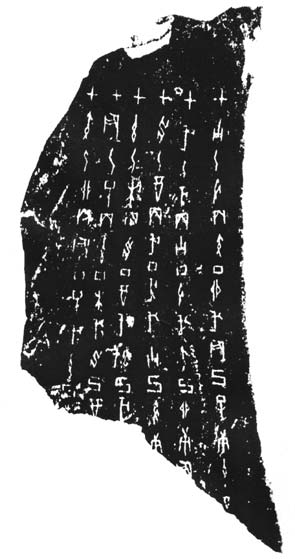
As already noted, Yin inscriptions contain both declarative and interrogative sentences. The latter express a general question, i.e., require a positive or negative answer: "yes" or "no" (sentences containing a specific question are not recorded in Yin texts).
In their form, declarative and interrogative sentences are no different:
王田 wáng tián — "The ruler is hunting"
王田 wáng tián — "Is the ruler hunting?"
Apparently, in archaic Old Chinese, a general question and a statement differed only in intonation, which we, naturally, cannot judge. Therefore, the only indication that a sentence is interrogative is the presence of the word 貞 zhēn — "to ask."
The word 曰 yuē is an indicator of direct speech in ancient Chinese.
It can be used independently: 王曰 wáng yuē — "Wang said: “...””.
Furthermore, this word can follow another significant word meaning "to speak", "to ask", etc.: 王占曰 wáng zhān yuē — "Wang read the answer: “...””.
When analyzing the structure of an ancient Chinese sentence, we assume that its center, i.e., the member without which the sentence as such ceases to exist, is the predicate. The predicate is the only member of the sentence that cannot be omitted under any circumstances.
The serial nature of Yin inscriptions makes it easy to find the predicate in each sentence of the series. If we write the inscriptions from Lesson 1 not as a continuous text, but as a distribution table (i.e., we divide the sentences so that words with the same grammatical function in different sentences are in the same vertical column), we obtain the following:
В древнекитайском языке существует два набора, или цикла, знаков, расположенных в определенной последовательности и использовавшихся для обозначения дней. В первом цикле — десять знаков: 甲 jiǎ, 乙 yǐ, 丙 bǐng, 丁 dīng, 戊 wù, 己 jǐ, 庚 gēng, 辛 xīn, 壬 rén, 癸 guǐ; во втором — двенадцать: 子 zǐ, 丑 chǒu, 寅 yín, 卯 mǎo, 辰 chén, 巳 sì, 午 wǔ, 未 wèi, 申 shēn, 酉 yǒu, 戌 xū, 亥 hài.
Первый знак первого цикла сочетается с первым знаком второго цикла, второй знак — со вторым и т. д. В совокупности получается 60 сочетаний:
| 1. 甲子 jiǎ zǐ |
2. 乙丑 yǐ chǒu |
3. 丙寅 bǐng yín |
4. 丁卯 dīng mǎo |
| 5. 戊辰 wù chén |
6. 己巳 jǐ sì |
7. 庚午 gēng wǔ |
8. 辛未 xīn wèi |
| 9. 壬申 rén shēn |
10. 癸酉 guǐ yǒu |
11. 甲戌 jiǎ xū |
12. 乙亥 yǐ hài |
| 13. 丙子 bǐng zǐ |
14. 丁丑 dīng chǒu |
15. 戊寅 wù yín |
16. 己卯 jǐ mǎo |
| 17. 庚辰 gēng chén |
18. 辛巳 xīn sì |
19. 壬午 rén wǔ |
20. 癸未 guǐ wèi |
| 21. 甲申 jiǎ shēn |
22. 乙酉 yǐ yǒu |
23. 丙戌 bǐng xū |
24. 丁亥 dīng hài |
| 25. 戊子 wù zǐ |
26. 己丑 jǐ chǒu |
27. 庚寅 gēng yín |
28. 辛卯 xīn mǎo |
| 29. 壬辰 rén chén |
30. 癸巳 guǐ sì |
31. 甲午 jiǎ wǔ |
32. 乙未 yǐ wèi |
| 33. 丙申 bǐng shēn |
34. 丁酉 dīng yǒu |
35. 戊戌 wù xū |
36. 己亥 jǐ hài |
| 37. 庚子 gēng zǐ |
38. 辛丑 xīn chǒu |
39. 壬寅 rén yín |
40. 癸卯 guǐ mǎo |
| 41. 甲辰 jiǎ chén |
42. 乙巳 yǐ sì |
43. 丙午 bǐng wǔ |
44. 丁未 dīng wèi |
| 45. 戊申 wù shēn |
46. 己酉 jǐ yǒu |
47. 庚戌 gēng xū |
48. 辛亥 xīn hài |
| 49. 壬子 rén zǐ |
50. 癸丑 guǐ chǒu |
51. 甲寅 jiǎ yín |
52. 乙卯 yǐ mǎo |
| 53. 丙辰 bǐng chén |
54. 丁巳 dīng sì |
55. 戊午 wù wǔ |
56. 己未 jǐ wèi |
| 57. 庚申 gēng shēn |
58. 辛酉 xīn yǒu |
59. 壬戌 rén xū |
60. 癸亥 guǐ hài |
Thus, the first day of the 60-day cycle is designated by the combination 甲子 jiǎ zǐ, the last by 癸亥 guǐ hài; then comes 甲子 jiǎ zǐ again, and so on. If the context makes it clear which ten-day period is being referred to, the second character in the combination could be omitted.
Combinations of cyclic characters are used in ancient Chinese only as nouns, more specifically, as adverbial modifiers of time. Therefore, such a combination of characters, used without a preposition, can serve as an indication of the beginning of a sentence: 甲子 jiǎ zǐ 允其雨 yǔn qí yǔ — "On the day of Jia Zi, it really rained."