GRAMMAR COMMENT
12.1. Text Division Techniques (continued)
One of the specific techniques for dividing Zhou inscriptions into sentences is related to the fact that these types of texts often contain rhyming parts. By determining which words rhyme with each other, one can find the boundary between
the end of one sentence and the beginning of another, since the sentence here coincides with the line of poetry.
Of course, it should be taken into account that the modern reading of signs
is quite different from the ancient one.
In our text, the phrases 有勳于周邦 yǒu xūn yú zhōu bāng, 佑辟四方 yòu pì sì fāng, 惠弘天命 huì hóng tiān mìng rhyme.
12.2. Modal Predicatives
In pre-classical Chinese, a group of notional words appears, used exclusively in a predicative function—the so-called modal predicatives. Like all other words in the predicative function, they can be negated: 不 bù, 弗 fú, and others. However, the specificity of modal predicatives is that they cannot express actions or states on their own and therefore require another predicative after them.
The main predicative immediately follows the modal.
The total number of modal predicatives in the early preclassical language is small. In authentic texts from the Zhou period, almost only two of them are found: 克 kè "to be able", "to be able" and 敢 gǎn "to dare", "to resolve":
乃祖考克左右先王 nǎi zǔ kǎo kè zuǒ yòu xiān wáng "Your grandfather and father were able to help the late rulers."
汝勿敢不善 rǔ wù gǎn bù shàn "Don't dare do badly!"
The notional word 欲 yù "to want" should apparently be distinguished from modal predicatives in the early preclassical language. It can function both predicatively and nominally. On the other hand, 欲 yù can refer not only to a predicative, but also to an entire embedded clause:
欲弗作先王忧 yù fú zuò xiān wáng yōu "I want [us] not to cause trouble to the deceased rulers."
12.3. Aspect-Tense Markers in Predicatives
A characteristic feature of the archaic Old Chinese language is its complete lack of any
grammatical means of expressing the aspect and tense of a predicative.
Let's recall a typical Yin inscription in this regard: 翌甲子其雨, 甲子允雨 yì jiǎ zǐ qí yǔ, jiǎ zǐ yǔn yǔ "Will it rain
on the next Jia Zi day? On Jia Zi day, it indeed rained
."
The first sentence refers to an action expected in the future, while the second refers to an already accomplished fact. However, these differences between them are not formally expressed and are determined solely by context.
Special function words that serve as aspect-tense markers first appear in the Early Preclassical language. Moreover, the Old Chinese language of this period is characterized by the optionality of aspect-tense markers. They
only clarify the characteristics of the action expressed by the predicate and, under certain conditions, can be omitted.
Aspect-tense markers are placed immediately before the predicate to which they refer.
One of the markers of this gender, characteristic of pre-classical languages, is 肇 zhào. It indicates that the action or state expressed by the predicate has just begun and is not yet
completed:
肇從父征 zhào cóng fù zhēng "Just set out
on a campaign following my father."
今余肇令汝 jīn yú zhào lìng rǔ
- Copy the text and underline the words in it that could rhyme. Determine whether they always appear at the end of a sentence.
- Translate the text into English.
- Translate the following sentences into Old Chinese:
- I dare not accept this precious ritual vessel.
- The king will grant you the scarlet loincloth the following day.
- His son has just taken over the management of the forest lands.
- Your grandfather was able to enter his hall.
ЛЕКСИЧЕСКИЙ КОММЕНТАРИЙ
12.А. Копирование образцов
Одним из важнейших социально-этических представлений эпо-
хи Чжоу, которые в несколько трансформированном виде легли в основу возникшего несколькими веками позже конфуцианского
учения, было восприятие традиции, следование уже существую-
щему образцу. Не активное творчество, а копирование того, что уже сделано предками, — таков основной идеологический лозунг
господствующего слоя западночжоуского общества.
Для правителя таким идеальным образцом была деятельность «прежних ванов». Каждый представитель знати в свою очередь считал высшей добродетелью подражание своим собственным
прародителям, «не смея не брать за образец своих усопших пред-ков».
12.Б. Термины родства
Система терминов родства, зафиксированная в западночжоу-ских надписях, в целом совпадает с иньской. Единственным суще-
ственным отличием раннечжоуской системы от иньской является термин 考 kăo, соответствующий 父 f ù («отец», «брат отца»), но
применяемый только по отношению к умершему родственнику.
Словосочетание 祖考 zǔ kăo обычно имеет значение «усопшие
предки».
Напомним, что 祖 zǔ, как и 孫 sūn, обозначали не только деда
и внука, но и родственников более отдаленных поколений.
12.В. Сын Неба 天子 tiān zǐ
Чжоуские ваны присвоили себе титул «Сын Неба», подчерки-вающий священное происхождение власти правителя и его исклю-
чительное положение среди смертных. Этот титул упоминается в надписях начиная с середины X в. до н. э. Одновременно с этим
чжоуские ваны по-прежнему использовали и прежний иньский ти-тул правителя «Я, единственный среди людей»).
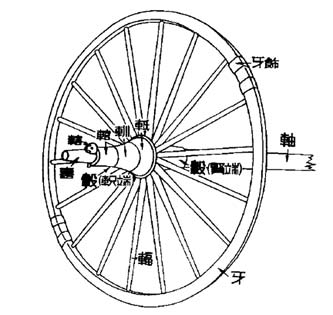
12.Г. «Металлические колесницы»
Чжоуские боевые колесницы по своей конструкции были пол-
ностью аналогичны иньским. Они, как и раньше, изготавливались из дерева, но ряд наиболее важных деталей требовал применения
металла. Без бронзовых втулок, например, колесница была бы не-долговечной.
Поэтому в чжоуских надписях часто упоминается о том, что правитель дарил своим подчиненным отлитые из бронзы детали
колесниц, а сами эти боевые повозки нередко называются «метал-лическими».