GRAMMATICAL COMMENTARY
2.1. Direct Object
The direct object usually comes after the predicate.
In the texts provided, the presence of a direct object is determined by the features a) omission and b) replacement of a sentence element in post-predicate position:
a) 受年 (shòu nián) ‘to receive harvest’;
弗受年 (fú shòu nián) ‘not to receive [harvest]’;
b) 來牛 (lái niú) ‘to send oxen’;
來犬 (lái quǎn) ‘to send dogs’.
2.2. Attribute
Attributes in archaic, as well as in general Old Chinese, always precede the modified word:
白馬 (bái mǎ) ‘white horse’;
稻年 (dào nián) ‘rice harvest’;
今春 (jīn chūn) ‘this spring’.
2.3. Personal Pronouns
Personal pronouns are a functional part of speech, always used in a strictly defined grammatical function, replacing nouns. A personal pronoun cannot be used as a predicate.
Personal pronouns possess all the syntactic properties of nouns, except one: they cannot take attributes.
Personal pronouns in Old Chinese are differentiated by person. Number is expressed inconsistently. For example, the first person pronoun 我 (wǒ) can be used in both singular (‘I’) and plural (‘we’).
2.4. Adverbial Nouns
Old Chinese has a group of adverbial nouns denoting a point in space or time. This includes the word 今 (jīn) ‘now’, ‘at the present moment’. It can be used independently, functioning as an adverb of time, or as an attribute to another noun:
今雨 (jīn yǔ) ‘Is it raining now?’
今歳我受年 (jīn suì wǒ shòu nián) ‘This year we will receive harvest?’ (今歳 (jīn suì) ‘this year’).
In archaic language, certain other content words can also be used in this function. For example, 來 (lái) ‘to come’, when used as an attribute to a noun, acquires the meaning ‘future’, ‘next’:
來歳我弗受年 (lái suì wǒ fú shòu nián) ‘Next year we will not receive harvest’ (來歳 (lái suì) ‘next year’).
However, unlike 今 (jīn), the word 來 (lái) cannot be used independently in this meaning.
2.5. Basic and Causative Meaning of Predicate
A content word functioning as a predicate can have multiple meanings in archaic Old Chinese. One of them — the basic — belongs to the predicate that denotes an action carried out by the subject. Alongside it, the same word can have another — causative — meaning, i.e., to denote an action that the subject causes to be performed.
For example, if the content word 來 (lái) means ‘to come’, ‘to arrive’, then in another context it can mean ‘to make someone/something come’, i.e., ‘to send’, ‘to deliver’.
The same applies to the predicate 受 (shòu) ‘to receive’, whose causative meaning is ‘to make someone receive’, i.e., ‘to give’, ‘to grant’, etc.
Note that in later Old Chinese texts, the difference between basic and causative meanings of predicates is expressed graphically. The word meaning ‘to receive’ is written with the character 受 (shòu), while ‘to give’ is written with 授 (shòu):
男女授受不親 (nán nǚ shòu shòu bù qīn) ‘When a man and a woman give or receive something, they should not touch each other’.
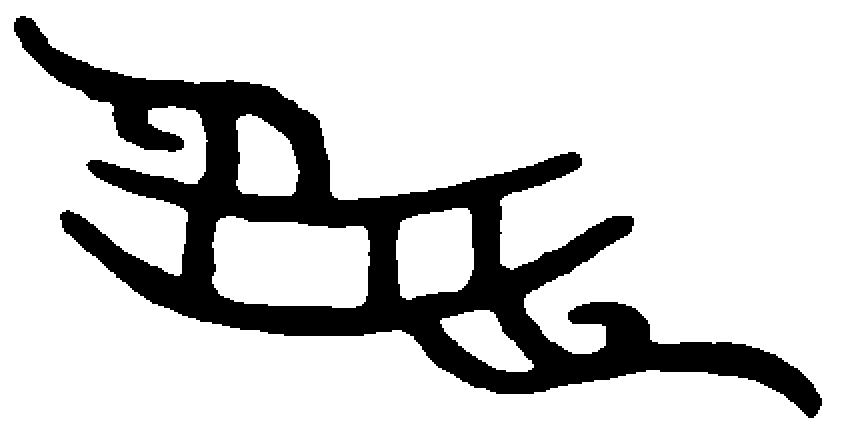
2.6. Negation fu
In this lesson, we encounter another functional word belonging to the group of negations — 弗 (fú). Like 不 (bù), it is neutral, i.e., it merely indicates the negation of the action expressed by the following predicate:
方出 (fāng chū) ‘The tribe will go out’;
方弗出 (fāng fú chū) ‘The tribe will not go out’.
In most cases, 弗 (fú) and 不 (bù) are interchangeable:
不受年 (bù shòu nián)
弗受年 (fú shòu nián)
However, 弗 (fú) is not used before impersonal predicates, nor in cases where the object of the predicate is expressed by a pronoun (see 5.3).