GRAMMAR COMMENTARY
22.1. Personal Pronoun 其 qí
One of the significant features distinguishing the late Preclassical language from previous periods is the transformation of the personal pronoun system.
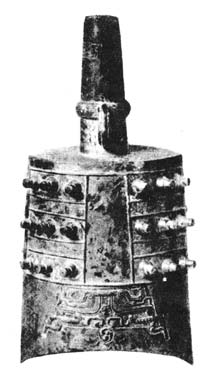
Specifically, during this period, a new personal pronoun, 其 qí, appeared, replacing 厥 jué. In 6th-century BCE monuments, 其 qí, as a third-person personal pronoun used to describe a noun, coexists with the earlier 厥 jué. An example of this is the first part of Lesson 22, where phrases with the same meaning, "his ringing bell," use different pronouns: 厥和鐘 jué hé zhōng and 其和鐘 qí hé zhōng.
Later, the pronoun 厥 jué falls out of use. In classical texts, it appears only as an archaism: in quotations from the Shanshu and Shijing, as well as in official documents (treaties, ambassadorial speeches), etc.
Along with the gradual displacement of 厥 jué by 其 qí, the function word 其 qí in its original adverbial meaning is also disappearing. In this sense, texts from the 6th century BCE demonstrate the coexistence of old and new.
In this lesson, the word 其 qí appears both as a pronoun and as an adverb: 其 萬 年 無 疆 qí wàn nián wú jiāng "for ten thousand years to have no end."
22.2. Function word 而 ér
The word 而 ér, not found in the early preclassical language, is classified as a conjunction. We are already familiar with the conjunction 眔 dà, which typically connects names: 令 眔 奮 lìng dà fèn "Lin and Fen"; 馬 眔 羊 mă dà yáng "horses and rams".
Unlike 眔 dà, which connects two or more independent elements, the conjunction 而 ér is used to express a coordinating relationship between names that characterize the same object or person from different perspectives. In our text, 義楚之良臣 yì chǔ zhī liáng chén "the devoted servant of I-chu" and 僥之慈父 yáo zhī cí fù "the virtuous father Yao" are not two persons, but one (the same person is a servant of a certain I-chu and at the same time is the father of his son, named Yao). This circumstance is clarified by the introduction of the conjunction 而 ér between the names. The same in Lesson 23: 襄公之出而成公之女 xiāng gōng zhī chū ér chéng gōng zhī nǚ "Xiang Gong's sister's daughter, [also] Cheng Gong's daughter."
22.3. Predicate Inversion
In early preclassical Chinese, there was a construction used to logically emphasize the predicate. This construction was not applied to any predicate, but only to those that characterize the state of the subject and are expressed by a qualitative predicate.
In the late preclassical language, such predicates, when logically distinguished, are formed differently—with the function word 哉 zāi (in postposition). A sentence with an inverted predicate of this type acquires an emotionally emphasized stylistic tone: 善 哉 民 之 主 shàn zāi mín zhī zhǔ "How virtuous is the ruler of the people!" Lin Fang asked about the essence of the norms of relationships between people. The teacher exclaimed: "The question is most important!" A nominal predicate can be inverted in the same way: 君 哉 舜 也 jūn zāi shùn yĕ "Shun is the ruler!"
LEXICAL COMMENTARY
22.A. Hua, ruler of the state of Zhu
The hereditary domain of Zhu was located during the Eastern Zhou period in the southwestern part of the Shandong Peninsula.
A ruler of this kingdom named Hua is mentioned in the Spring and Autumn Chronicle under the first year of the reign of Emperor Zhao of Lu, i.e., in 541 BC.
22.B. A Certain Yichu from the Kingdom of Xu
South of Zhu lay the kingdom of Xu.
The Zuozhuan chronicle reports that in the sixth year of the reign of Emperor Zhao of Lu (536 BC), a certain Yichu from the kingdom of Xu traveled to Chu but was captured and detained there. He subsequently managed to escape and return home. The second text of Lesson 22 mentions a servant of Yichu of Xu. This serves as the basis for the dating of the inscription.