GRAMMAR COMMENTARY
23.1. Personal pronoun 而 ér
Changes in the personal pronoun system that occurred in the late preclassical period also affected second-person pronouns. Here, 乃 năi, which was used as a noun modifier, was replaced by the new pronoun 而 ér. This change was not sudden, so in texts from the 6th century BCE, we observe the coexistence of two phenomena, one of which had already effectively become obsolete, while the other was only just coming into its own.
In this text, we encounter both 乃 năi and 而 ér in the same meaning and even in the same passage: 官 執 而 政 事,余 弘 厭 乃 心 guān zhí ér zhèng shì, yú hóng yàn năi xīn "Go about your affairs related to governance; I am highly satisfied with your intentions."
23.2. Distribution of Appendix Elements
In Archaic and Early Preclassical languages, the personal name always follows the status designation: 膳 夫 克 shàn fū kè "lawyer Ke"; 史 毛 shǐ máo "historiographer Mao"; 作 册 大 zuò cè dà "archivist Da".
However, beginning in the Late Preclassical period, this distribution changes. Now the name comes first, and the status designation comes second. An example of this is found in the text of Lesson 23: 伊小臣 yī xiăo chén "xiaochen Yi" (cf. in the archaic language: 小臣葉 xiăo chén yè "xiaochen Ye").
The distribution of appositional elements, which appeared in the 6th century BCE, is characteristic of the entire subsequent history of the Chinese language, right up to modern times.
23.3. The Functional Word 是 shì
The function word 是 shì, noted in the emphatic construction (21.3), is also used with another meaning. In the Late Preclassical period, it is close to the adverb 其 qí of the archaic period: this word essentially only indicates that a predicate follows. This use of the function word 是 shì is characteristic exclusively of the Late Preclassical period; in the Classical period, it changes its meaning.
LEXICAL COMMENTARY
23.A. Yu the Great
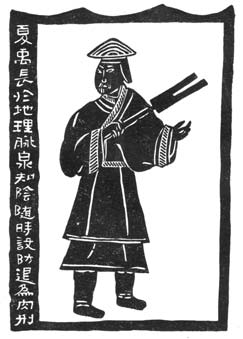
According to legend, the Celestial Empire was once suffering from a flood. Many heroes tried to save it, but their efforts were futile. Then a certain Yu took up the cause. He deepened the riverbeds and dug gorges where the mountains had been. The waters receded, and the people were saved. Yu became the ruler of the Celestial Empire, and after his death, his son succeeded him. Thus arose the Xia Dynasty.