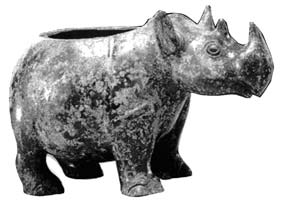
Из таких сосудов древние китайцы пили вино
In the texts under consideration, we encounter for the first time a new category of function words—the so-called final particles. They can be divided into two groups.
The first of these will be called neutral final particles. They indicate a pause, which most often occurs at the end of a sentence, but can also emphasize a particular part of the sentence.
The most important neutral final particle is 也 yě. In the first text of this lesson, we also encounter the particle 殹 yī, which appears to be a dialectal variation of 也 yě.
The second group of final particles consists of exclamatory particles. They not only indicate the end of a sentence but also carry additional emotional load. 矣 yǐ is one of these.
Final particles, which first appear in the late Preclassical period, are still quite rare in texts of this period. Their widespread use is a characteristic of the next stage in the history of the Old Chinese language.
The pronoun 彼 bǐ denotes something distant in space and can be translated as "that." When used as a subject or object, 彼 bǐ often functions as a third-person personal pronoun (although, strictly speaking, third-person personal pronouns as such did not exist in either the Preclassical or Classical period).
We will provide examples of the use of 彼 bǐ in various functions.
Subject
彼 有 旨 酒 又 有 嘉 殽 bǐ yǒu zhǐ jiǔ yòu yǒu jiā yáo "They have delicious wines and excellent dishes."
Object
在 彼 zài bǐ "to be there."
Definition
彼 黍 離 離 bǐ shǔ lí lí "That millet has sprouted."
The interrogative word 曷 hé, which existed in the Early Preclassical period, was replaced in the Late Preclassical period by a whole group of new interrogative words, among which 何 hé is the most common.
何 hé initially appeared as an interrogative adverb, but later acquired a wider range of grammatical functions.
It can be an attribute of the subject, object, or predicate: 此 何 人 哉 cǐ hé rén zāi "What kind of people are these?" In addition, 何 hé can act as a nominal predicate, which is most often formed with the particle 唯 wéi: 其 釣 唯 何, 唯 魴 唯 鱮 qí diào wéi hé, wéi fáng wéi xù "What's the catch? Bream and tench."
Finally, 何 hé can be an object: 我 何 求 wǒ hé qiú "What am I looking for?" Note that the object expressed by the interrogative word 何 hé cannot occupy its usual position and always comes before the predicate.
However, if hé 何 replaces an indirect object with prepositions 以 yǐ, 與 yǔ, etc., it comes before the preposition, not after it:
何 以 穿 我 屋 hé yǐ chuān wǒ wū "What is he using to poke holes in my roof?"
The poetry of the Shijing contains special cases of predicate inversion, determined by the specific nature of the poetic form.
The subject may be preceded by a predicate expressed by a double notional word denoting a quality or state:
芃 芃 其 麥 péng péng qí mài "I see how the wheat is turning lushly yellow all around" (lit. "wheat is earing")*.
A qualitative predicate expressed by two homogeneous qualitative predicates can also be inverted: 黃 白 其 鯾 huáng bái qí biān "The fins are yellow and white."
If an inverted qualitative predicate is expressed by a single word, the subject is usually formed by the demonstrative pronoun 彼 bǐ:
宛 彼 鳴 鳩 wăn bǐ míng jiū "Let the songbird be small"**.
泛 彼 柏 舟 fàn bǐ băi zhōu "So the cypress boat floats away easily."***.
A few comments should be made regarding the last type of inversion. The pronoun 彼 bǐ can, of course, act as an attribute not only of the subject but also of the object.
To distinguish the subject following the inverted predicate from the one occupying its usual object position, it is necessary to analyze the meaning of the predicate. If it expresses an action, direct word order is most likely; if it expresses a quality, we are justified in assuming an inversion of the predicate.
Example of a sentence with direct word order (彼 bǐ specifies the object):
瞻 彼 洛 矣 唯 水 泱 泱 zhān bǐ luò yǐ wéi shuǐ yāng yāng "On Luo, look how wide and deep the river's waters are."*
Here 瞻 zhān "to look at something" is a predicative, denoting an action and therefore requiring an object after it.
* Shijing. P. 68.
** Ibid. P. 260.
*** Ibid. P. 35.
The notional word 如 rú is used in the predicative meaning "to be similar to," "to be alike." It is gradually replacing the similar predicative 若 ruò.
In Lesson 23, we encountered the predicative 若 ruò with an object expressed by a noun (靈 力 若 虎 líng lì ruò hǔ "Miraculous power is like a tiger");如 rú can have an object expressed not only by a noun but also by a predicative phrase: 如 臨 深 淵, 如 屢 薄 冰 rú lín shēn yuān, rú lǚ báo bīng "like approaching a deep rapid; like stepping on thin ice."
In both Early and Late Preclassical Chinese, the nominal predicate is disjointed: it immediately follows the subject and is not formalized in any way.
However, in a negative sentence with a nominal predicate, the usual negation 不 bù is not used, but a special negative copula 匪 fěi (in texts of the classical period — 非 fēi): 我 心 匪 石 wǒ xīn fěi shí "My heart is not stone."
In ancient China, mats woven from grass or thin strips of split bamboo were a staple of home furnishings. The floor was completely covered with mats: people sat, slept, and ate on them. At night, special sleeping mats were laid out, which were rolled up and put away during the day. This property of the mat—its ability to roll up—is used as a poetic image in this song of the "Shijing."
The rivers of the Central China Plain are not very rich in fish, so fish was considered a delicacy in ancient times. Particularly prized species of fish included bream (魴 fáng), carp (鯉 lǐ), tench (鱮 xù), and some others.
We've already mentioned that in ancient China, bronze vessels were often cast in the shape of various animals. Lesson 26 mentions a rhinoceros-shaped vessel.
The ancient Chinese drank wine from such vessels.
A. A. Shtukin's translation (see below, p. 452: "I poured wine into the heavy horn of a rhinoceros") contains a clear error.