GRAMMAR COMMENTARY
40.1. The constructions 所與...者... suǒ yǔ... zhě and 所以...者... suǒ yǐ... zhě
The function words 所 suǒ and 者 zhě differ from each other in that the former, when combined with a predicative, forms a noun phrase—the object of an action, while the latter—its subject.
However, in some cases, both function words are used together, referring to the same predicative. This most often occurs when the predicate has an indirect object, formed by the prepositions 與 yǔ or 以 yǐ.
The phrase 所與...者 suǒ yǔ... zhě means "someone who, together with..., performs an action":
良人所與飮食者 liáng rén suǒ yǔ yǐn shí zhě "Those with whom the husband drank and ate."
所 suǒ can be omitted in this case without any loss of meaning:
其與飮食者 qí yǔ yǐn shí zhě "those with whom he drank and ate."
The construction 所以...者 suǒ yǐ... zhě means "that with which (or whom) someone performs an action." In this case, the function word 之 zhī can be inserted after designating the subject of the action:
此心之所以合於王者 cǐ xīn zhī suǒ yǐ hé yú wáng zhě "that which makes this thought appropriate for the ruler's position";
人之所以求富貴利逹者 rén zhī suǒ yǐ qiú fù guì lì dá zhě "that which helps a person achieve wealth, nobility, profit, and the achievement of his goals."
But the presence of 之 zhī is by no means necessary here:
君子所以異於人者 jūn zǐ suǒ yǐ yì yú rén zhě "that which distinguishes a noble person from other people."
Note that in this construction, 者 zhě can also be omitted without losing the meaning:
此其所以敗也 cǐ qí suǒ yǐ bài yě "That is what caused his defeat."
40.2. Predicative Tense Markers
The system of tense and aspect markers, which first appeared in pre-classical languages, underwent significant development during the classical period.
In this lesson, we encounter one of the predicative tense markers absent in pre-classical languages: 嘗 cháng. This function word indicates that an action took place sometime in the past, and for the speaker, only the fact of this action is important, not its result:
王嘗語莊子以好樂 wáng cháng yǔ zhuāng zǐ yǐ hào yuè "You, ruler, once told Zhuangzi that you love music."
孟子嘗與我言於宋 mèng zǐ cháng yǔ wǒ yán yú sòng "Mencius once spoke with me in the Song kingdom."
In a negative sentence, 嘗 cháng can only be combined with 未 wèi, not with 不 bù:
未嘗有顯者來 wèi cháng yǒu xiǎn zhě lái "It has never happened that anyone famous came."
不 bù can only appear after 未嘗 wèi cháng as a second negation:
古之人未嘗不欲仕 gǔ zhī rén wèi cháng bù yù shì "There was never a case where people in ancient times did not want to hold a government position."
40.2.1. Table 5. Aspect-tense markers with predicatives in pre-classical and classical languages.
| Meaning |
Pre-classical |
Classical |
| Just begun action |
肇 zhào |
— |
| Ongoing action |
— |
方 fāng / 乍 zhā |
| Completed action |
既 jì |
已yǐ / 既 jì |
| An action that will happen in the near future |
將 jiāng |
將 jiāng / 且 qiě |
| An action that has not yet been completed |
尚 shàng |
尚 shàng / 猶 yóu |
| An action that happened in the past |
— |
嘗 cháng |
40.3. Attributive Adverb 盡 jìn
We have already encountered this word in the notional meaning "to exhaust," "to use up to the end." It is also used as an attributive adverb meaning "entirely," "completely" before a predicate, and "all," "everything without exception" before a nominal:
陳相見許行而大悦,盡棄其學而學焉 chén xiàng jiàn xǔ xíng ér dà yuè, jìn qì qí xué ér xué yān "Chen Xiang met Xu Xing and was extremely happy about it; He completely abandoned his teachings and became Xu Xing's disciple."
問其所與飲食者,盡富貴也 wèn qí suǒ yǔ yǐn shí zhě, jìn fù guì yě "And if you ask about those with whom he drank and ate, it turns out that they were all rich and noble people."
40.4. Preposition 從 cóng
Along with 自 zì and 由 yóu, prepositions denoting the starting point of an action in space or time, a new preposition with the same meaning appears in classical Chinese: 從 cóng.
Its grammatical properties differ significantly from the previous ones. While previously the normal position of an indirect object with the preposition 自 zì was post-predicate, and moving such an object to a position before the predicate was an inversion, now an object with the preposition 從 cóng can generally only appear before the predicate and is never placed after it:
施施從外來 shī shī cóng wài lái "He returned home in a good mood" (lit. "returned from outside").
Note that in the early classical language, the preposition 從 cóng was still very rarely used. Thus, in the Mencius, the preposition 自 zì appears 27 times, 由 yóu appears 26 times, and 從 cóng appears only three times. The widespread use of the preposition 從 cóng dates back to a later period.
LEXICAL COMMENTARY
40.A. Wife and Concubine
While rulers and members of the upper aristocracy in ancient China typically had several wives (their number corresponding to the husband's social status), polygamy among the lower aristocracy and commoners was by no means the norm. Everything depended on material resources, and if these were sufficient, a man, in addition to a wife (妻 qī), took concubines (妾 qiè). The latter's status was often little different from that of slaves. In this sense, the situation described by Mencius in the text under review, where a concubine allows herself to criticize her husband's actions, is hardly typical.
40.B. Cemetery in the Eastern Suburb
During the Zhang Guo Dynasty, any more or less large settlement was surrounded by walls and thus constituted a "city." Most often, a city had two walls—an outer and an inner one. Both were square or rectangular, oriented to the cardinal directions. Residential quarters were located behind the inner wall. The suburb (郭 guō), located between the walls, contained fields belonging to the city's residents, cemeteries, etc.
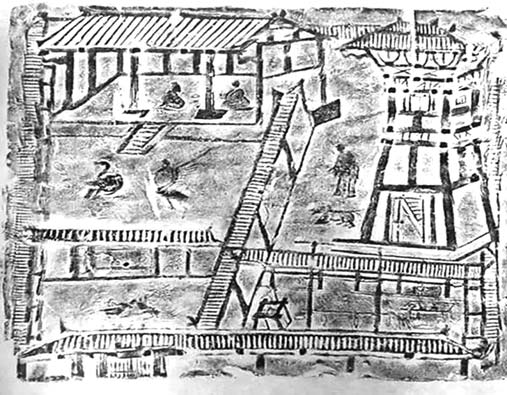
40.B. Urban Estate
As early as the middle of the first millennium BCE, In ancient China, the traditional type of urban estate gradually developed. It was separated from neighboring houses by a high fence or wall, representing a small, enclosed world. Entering through the gate, one first entered an inner courtyard, through which one could enter the house. The windows of the house faced only the courtyard. It is precisely these types of courtyards that are depicted on stone bas-reliefs of somewhat later times, dating back to the last centuries BC.