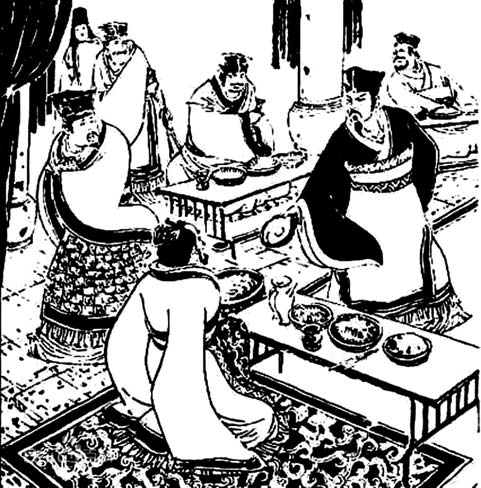
«Люди подворья» за хозяйским столом
We have already encountered some examples of the use of proper names as common nouns in the predicative function in the early classical language (38.1). A specific example of this type of use of proper names in the "Historical Records" of Sima Qian is the construction of the first mention of this name in a biography. In this construction, the proper name is used in the predicative function "to be called by a name" or "to be known by such-and-such a name":
平原君趙勝者 píng yuán jūn zhào shèng zhě "the one known by the name of Zhao Sheng, who bore the title Pingyuan-jun";
門下有毛遂者 mén xià yǒu máo suí zhě "Among his parasites was someone named Mao Sui."
From the pre-classical language, we know the function word 乃 nǎi (16.3), one of the functions of which was to indicate the chronological and logical sequence of actions. In this meaning, 乃 nǎi continues to be used in the Late Classical:
臣乃今日請處囊中 chén nǎi jīn rì qǐng chù náng zhōng "And so today I ask permission to be in the sack."
Along with 乃 nǎi, the Late Classical language begins to use a new function word, 即 jí, for the same purpose. Like 乃 nǎi, it usually comes before the predicate:
項伯許諾,即夜復去 xiàng bó xǔ nuò, jí yè fù qù "Xiang Bo agreed and set off back at night."
乃 nǎi and 即 jí have another meaning as well. They can be used as a connective tissue with the emphatic nuance "to be none other than...", "to be precisely...":
非其父兄,即其子弟 fēi qí fù xiōng, jí qí zǐ dì "[if] not his father or older brother, then certainly his younger brother or son";
Fan Kuai was an old friend of the emperor and a man of great merit, and he was none other than the husband of Lü Xu, the empress's younger sister.
The phrase 於是 yú shì is used as a synonym for 乃 nǎi and 即 jí in their primary meaning—to express a sequence of actions—but, unlike them, can appear before both the predicate and the subject:
王於是曰 wáng yú shì yuē "And then the ruler said: '...”"
於是王召見 yú shì wáng zhào jiàn "And then the ruler summoned him."
Sometimes the phrase 於是 yú shì, when placed before the subject, is duplicated by 乃 nǎi, which is placed before the predicate:
於是平原君乃斬笑躄者美人頭 yú shì píng yuán jūn nǎi zhǎn xiào bì zhě měi rén tóu "And then Pingyuan-jun chopped off the head of the beauty who laughed at the lame man."
A subordinate clause of cause usually appears before the main clause in a complex sentence and is joined to it by the conjunction 故 gù (17.2). However, such a subordinate clause can also appear after the main clause. For this, a combination of function words 者以 zhě yǐ is used, the first of which closes the main clause, and the second introduces a subordinate clause:
士不遠千里而至者,以君能貴士 shì bù yuǎn qiān lǐ ér zhì zhě, yǐ jūn néng guì shì "The men came, not counting the distance of 1000 li, because you are able to appreciate them."
Another way to form a subordinate clause of cause in a postposition is to attach it to the main clause using the conjunction 蓋 gài:
孔子罕稱命,蓋難言之也 kǒng zǐ hǎn chēng mìng, gài nán yán zhī yě "Confucius rarely spoke about fate because it is difficult to talk about."
Besides the above, the function word 蓋 gài has another meaning in the late classical language. It indicates that the message recorded in this sentence is not absolutely reliable, that the author has certain doubts about it, etc. The word 蓋 gài behaves in this case as an adverb and is placed before the predicate. It can be translated into English as "they say that...", "according to rumors", "as if":
太史公曰余登箕山,其上蓋有許由塚云 tài shǐ gōng yuē yú dēng jī shān, qí shàng gài yǒu xǔ yóu zhǒng yún "Taishigong said: 'I climbed Mount Qishan, where they say Xu Yu's tomb is located.'"
In the example given, the final 云 yún duplicates the preceding 蓋 gài, although it can also convey the corresponding meaning on its own:
見大人跡云 jiàn dà rén jī yún "As if they saw the footprints of a giant."
The preposition 因 yīn is close in meaning to 以 yǐ, grammatically belonging to the same group (21.5).
因 yīn, just like 以 yǐ, denotes an instrument of action, but not in a literal, but in a figurative sense, that is, it indicates the circumstances, conditions or persons thanks to which this action was possible:
今政治和平,世無兵革,上下相安,何因當有大水一日暴至 jīn zhèng zhì hé píng, shì wū bīng gé, shàng xià xiāng ān, hé yīn dāng yǒu dà shuǐ yī rì bào zhì "Now a just government is being exercised, there are no wars in the world, the upper and lower classes are at peace, so why would a flood suddenly start?"
魏使人人因平原君請縱於趙 wèi shǐ rén yīn píng yuán jūn qǐng zòng yú zhào "The state of Wei sent a man to conclude an alliance with Zhao through Pingyuan-jun."
This phrase is used to express a rhetorical question, "isn't it...", "after all," etc.:
學而時習之,不亦悦乎 xué ér shí xí zhī, bù yì yuè hū "Studying and constantly repeating what you've learned, isn't that joyful?"
During the Zhangguo era, many high-ranking officials were given the title of "governor" (君 jūn) of a particular region. Zhao Sheng of the State of Zhao was the governor of the Pingyuan region.
Aristocrats of the Zhangguo era often kept a large number of hangers-on in their homes, consisting of wandering scholars or other figures who had found no place in government service. Such people were called 賓客 bīn kè "guests," 舍人 shè rén "people of the courtyard," 食客 shí kè "freeloaders," 門下 mén xià "people at the gate."
"People of the courtyard" at the master's table
The aristocrat in whose house they lived fed them, and they, in turn, served him with their knowledge and, if necessary, with their strength.