GRAMMAR COMMENTARY
42.1. Adverbial modifier of time
In the late classical language, the adverbial modifier of time is more often
than previously found in a postposition to the subject and never
takes a preposition: 臣乃今日請處囊中 chén nǎi j īn rì qǐng chù náng zhōng "And so today I ask permission to be in the sack."
The extended adverbial modifier of time can be expressed
by an included clause (i.e., a dependent clause perceived as a noun phrase). An indicator of the non-independence of such a sentence is the function word 之 zhī, standing between the subject and the predicate: 夫君子之居喪, 食不甘, 聞樂不樂 fū jūn zǐ zhī jū sāng, shí bù gān, wén yuè bù lè “When a noble person wears mourning, he eats and does not taste the food, listens to music and does not rejoice in it.”
The included clause can be separated by the function
word 也 yě: 賢者之治國也,蚤朝宴退 xián zhě zhī zhì guó yě, zǎo
cháo yàn tuì "When a wise man governs a state, he
begins audiences earlier and leaves the palace later."
However, a characteristic feature of the late classical language is precisely that final particles (and especially 也 yě)
are used in texts much less frequently than before. Therefore, in general, the language of the time period in question is characterized by included clauses as adverbial modifiers of time, introduced without the
formation of a final particle:
秦之圍邯鄲... qín zhī wéi hán dān...”[When the troops]
Qin surrounded Handan...”
42.2. Included clauses in simile constructions
In the late classical period, the disyllabic predicatives 譬若 pì ruò and 譬如 pì rú became widespread. They were used in simile constructions in which the phenomena being compared were expressed either by names or included clauses: 賢士之處世也, 譬如錐之處囊中 xián shì zhī chù shì
yě, pì rú zhuī zhī chù náng zhōng "A wise man lives
in the world like an awl in a bag."
42.3. Expressing an Unrealistic Condition
We are familiar with several ways of expressing a conditional
subordinate clause. All of them are used in cases where the condition in question is feasible, at least theoretically. If an unrealistic condition is meant, other means of grammatical construction of the subordinate clause are used. One such means is the word nǎi before the main clause (the subordinate clause is preceded by the usual shǐ): shǐ suí zǎo dé chù náng
zhōng, nǎi yǐng tuō ér chū "If [Mao] Sui had managed to get into the bag earlier, he would have come out completely."
42.4. Negative Form of Restrictive Constructions
Phrases such as "not only..." and "not only... but also" are formed in classical Chinese from ordinary restrictive constructions using the negative copula 非 fēi:
非徒無益而又害之 fēi tú wú yì ér yòu hài zhī "This is not only
useless, but also harmful."
非獨賢者有是心也 fēi dú xián zhě yǒu shì xīn yě "Not
only the wise are able to sense this."
非特其末見而已 fēi tè qí mò jiàn ér yǐ “The matter will not be limited only to the fact that its tip will be visible.”
LEXICAL COMMENTARY
42.A. Handan
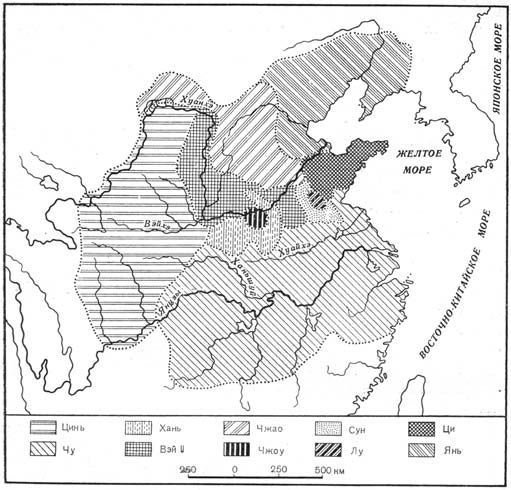
The city of Handan, the capital of the Zhao kingdom, was one of the largest trade and craft centers of the second half of the first millennium BC, with a population of several thousand households.
42.B. "Vertical Alliance"
In their struggle against their opponents, the largest kingdoms of the Zhao era did not rely solely on their own strength and sought to enlist the support of other states. Thus, gradually, two camps emerged on the Central Plain, more or less stably opposing each other.
The Qin kingdom maintained good relations with Qi, which
had no common borders with it and, therefore, no territorial claims. The alliance of Qin and Qi, known as the "horizontal alliance" (連橫 lián héng), was directed alternately against Chu, Zhao, and Wei. Zhao, in turn, relied on Chu for assistance in its struggle against its aggressive western neighbor. The alliance of Zhao and Chu went down in history as the "vertical alliance" (合縱 hé zòng; this phrase was also written as 合從 hé zòng). An attempt to conclude such an alliance was made by the Zhao dignitary Pingyuan-jun.