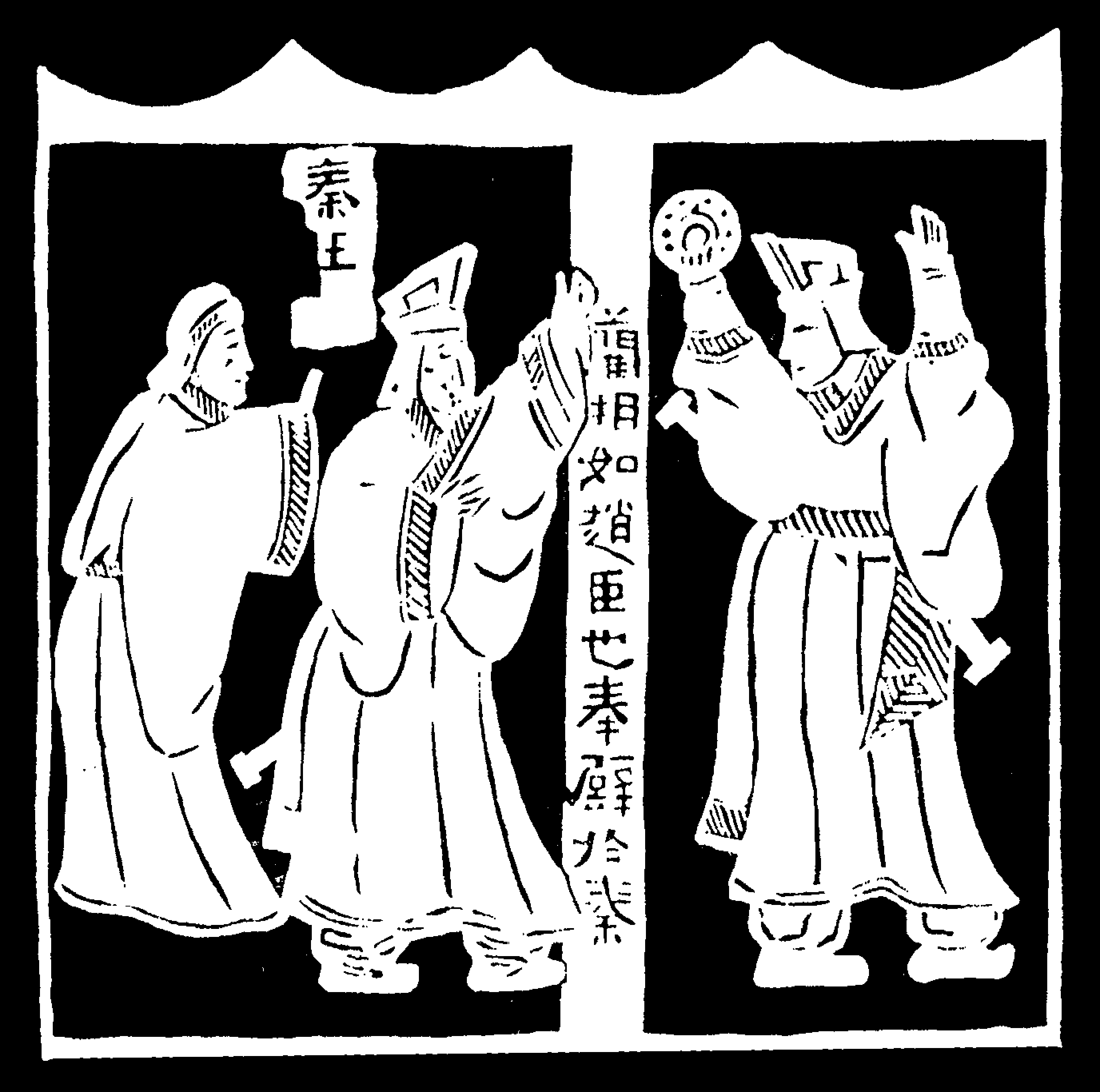
Линь Сянжу, подданный царства Чжао,
подносит яшму циньскому
правителю
(с ханьского барельефа)
The function word 皆 jiē, discussed in previous lessons (38.7; 45.1), refers to either the subject or a forward-facing object. The function word 悉 xī, which has the same general meaning, differs from 皆 jiē in that it refers to a postpositional object. Most often, it is
related in meaning to a direct object:
項羽悉引兵渡河 xiàng yǔ xī yǐn bīng dù hé "Xiang Yu led all his troops back and crossed the river."
He became extremely angry, threw out all the pearl and jade jewelry, and scattered it
at the entrance to the palace.
But the word 悉 xī can also refer to an indirect object:
良悉以家財求客刺秦王 liáng xī yǐ jiā cái qiú kè cì qín wáng "[Zhang] Liang used all the money in his family to hire a man to assassinate the Qin ruler."
This text contains a sentence that clearly demonstrates the difference between 悉 xī and 皆 jiē:
趙王悉召群臣議皆曰秦貪 zhào wáng xī zhào qún chén yì jiē yuē qín tān "The ruler of the state of Zhao summoned all the dignitaries to a meeting, and they all said: 'Qin is greedy.'"
Here 悉 xī refers to the word "dignitaries," which is the direct object in this sentence, and 皆 jiē refers to the same word, but in the subject function.
The construction...尚...况...乎...shàng... kuàng... hū can be translated into English with the words "even A is that... so what can we say
about B?" or "A is that... and B is even more so." This construction appears in classical texts in several different variants:
a) After the first name or phrase (A), the function words 尚 shàng, 且 qiě, 猶 yóu, or their paired combinations can be used:
王者尚不能行之於臣下,况同列乎 wáng zhě shàng bù néng xíng zhī yú chén xià, kuàng tóng liè hū "Even a ruler cannot achieve this among his subjects, what can we say about those in equal positions?!"
中材以上且羞其行,况王者乎 zhōng cái yǐ shàng qiě xiū qí xíng, kuàng wáng zhě hū "Even people who are only slightly
above the average level are ashamed of their actions, not to mention rulers."
蔓草猶不可除,况君之寵弟乎 màn cǎo yóu bù kě chú
kuàng jūn zhī chǒng dì hū "Even a weed cannot be pulled out, much less the ruler's favored younger
brother."
"Even a ruler who has a thousand chariots, and he is afraid of poverty, but what can we say about the common people!
b) before the second name or phrase (B) can be used -
xia word 況 kuàng or phrases 而况 ér kuàng and 况
於 kuàng yú:
管仲且猶不可召,而况不為管仲者乎 guǎn zhòng qiě yóu bù kě zhào, ér kuàng bù wéi guǎn zhòng zhě hū “Even
Guan Zhong cannot be summoned, much less someone who is not Guan Zhong.”
鼠近於器尚憚投恐傷其器,况於貴臣之近主乎
shǔ jìn yú qì shàng dàn tóu kǒng shāng qí qì, kuàng yú guì
chén zhī jìn zhǔ hū "When a rat runs up to a vessel, people hesitate to throw anything at it for fear of breaking the vessel, and even more so when a noble official is
near the sovereign";
c) All auxiliary words in this construction, except for 況 kuàng, can be omitted:
一虜不可得見,况單于之面乎 yī lǔ bù kě dé jiàn,
kuàng shàn yǔ zhī miàn hū "They couldn't even see a single
barbarian, let alone the chanyu himself."
We have already encountered (47.2) a construction for denoting
the direction of movement from a certain point. There is a variant in which the function word 以 yǐ is followed not by a spatial marker, but by the predicative 來 lái (movement toward the speaker) or 往 wǎng (from the speaker):
從此以往 cóng cǐ yǐ wǎng "from here and further."
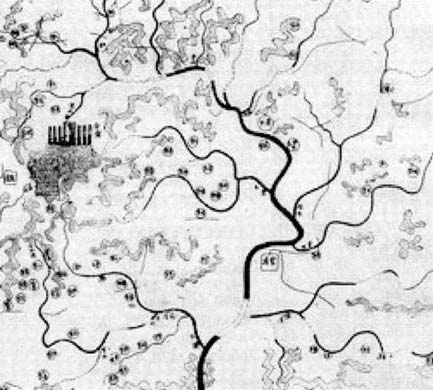
Primitive geographical maps probably appeared in China as early as the 4th–3rd centuries BC. In any case, when Liu Bang's troops entered the capital after the fall of the Qin Empire, he first of all took care to seize the "documents and maps" kept in the imperial chancery. The existence of a map of the Qin state by its ruler, Zhao Wang, is reflected in the cited text from Sima Qian's "Historical Records."