GRAMMAR COMMENTARY
5.1. Predicatives Requiring a Double Object
Notional words that serve as predicatives in archaic languages can be divided into several
groups.
One such group consists of predicatives that have the general
lexical meaning of "giving" or "taking away." These predicatives typically require two objects: a direct object, meaning the object of giving ("whom?", "what?"), and an indirect object, meaning the recipient or donor ("to whom?", "from whom?").
A formal feature of a sentence with a predicate expressed by a predicate of this group is that, firstly,
the indirect object with the meaning of the addressee with such predicates never takes a preposition and, secondly, it stands
immediately after the predicate before the direct object
(S - Dk - Dp):
帝受我年 dì shòu wǒ nián "Will the Heavenly Sovereign send us a harvest?"
洹弗作茲邑禍 huán fú zuò zī yì huò "Will the Huan River not
cause misfortune to this city?"
The usual position of the direct object immediately after the predicate is impossible in this case.
5.2. Inversion of Objects Without Prepositions
According to the word order existing in archaic Old Chinese, any object, if it is formed by a preposition, can be inverted and placed immediately before the
predicate. Inversion of objects without prepositions, however, is possible only under strictly defined conditions,
namely:
a) the predicate must be negative;
b) the object must be expressed by a pronoun.
This rule applies both to direct objects, which never take a preposition, and to indirect objects without prepositions in predicatives with the meaning of "giving and taking away":
帝熯我 dì hàn wǒ "Will the Heavenly Sovereign wither us?"
帝不我熯 dì bù wǒ hàn "Will the Sovereign of Heaven not dry us up?"
帝降我熯 dì jiàng wǒ hàn "Will the Sovereign of Heaven send us a drought?"
帝不我降熯 dì bù wǒ jiàng hàn "Will the Sovereign of Heaven not send us a drought?"
5.3. Two Types of Inversion
It should be noted that the inversion of a prepositionless object expressed by a pronoun in a negative
sentence differs significantly from the inversion of an object with a preposition.
In the latter case, the inversion is free and arbitrary.
An indirect object with a preposition can be inverted at the speaker's discretion, but it can also remain in its
usual position: the grammatical norms of the language equally allow both positions for such an object.
In contrast, the inversion of a prepositionless object under the conditions noted above is mandatory: the position of such an object before the predicate is the only possible one.
Another difference between the two types of inversion is that in the case of obligatory inversion, negation can only be expressed
with 不 bù (and not 弗 fú), as noted above (see 2.6):
帝弗受方佑 dì fú shòu fāng yòu "Will the Heavenly Sovereign not
send down help to the tribes?"
帝不我受佑 dì bù wǒ shòu yòu "Will the Heavenly Sovereign not
send down help to us?"
5.4. Personal Pronouns (continued)
The personal pronouns of archaic Old Chinese
can be divided into two categories.
The first category includes the already familiar first-person pronoun 我 wǒ. It is characterized by the following: firstly, it does not indicate number (it can be translated into English as either "I" or "we"); secondly, it can replace a noun in any of its functions (subject, object, attribute):
我受年 wǒ shòu nián "Will we get a harvest?"
帝受我年 dì shòu wǒ nián "Will the Heavenly Sovereign send us a harvest?"
我年有足雨 wǒ nián yǒu zú yǔ "Will our harvest have
enough rain?"
All personal pronouns of the second category are singular. They are characterized by the fact that they can perform
not all, but only certain nominal functions. From this
perspective, they can in turn be divided into two
groups.
The first group includes the first and second person personal pronouns 余 yú and 汝 rǔ. They can be both the subject
and object of a sentence:
余弗其作方禍 yú fú qí zuò fāng huò "I will not harm
the tribes?"
祖辛害余 zǔ xīn hài yú "Will Ancestor Xin harm me?"
The second group includes the first-person personal pronouns
朕 zhèn and the second-person 乃 naǐ. They are used exclusively
as modifiers of a noun:
羌其烖朕使 qiāng qí zāi zhèn shǐ "Will the Qiang defeat my ambassador?"
以乃使 yǐ năi shǐ "Bring your ambassadors!"
It should be noted that in archaic Old Chinese, third-person personal pronouns are completely absent.
Table 2
Functions of personal pronouns
in archaic Old Chinese
${data.meaning}
Phrases
馬方
mă fāng
"Ma tribe"
侯虎
hóu hǔ
"hou Hu"
LEXICAL COMMENTARY
5.A. Drought and "River Harm"
During the Yin period, artificial irrigation was not yet used.
Therefore, the fate of the harvest depended solely on the amount
and timing of natural precipitation. This explains
the Yin's significant interest in "whether there will be rain." Although the climate of the Central China Plain in the mid-2nd millennium BC was much more humid than it is today, there were times when the long-awaited rain never came, threatening the crops. Conversely, when the rainy season began, the Yin faced another danger. The Yellow River and its tributaries flooded, causing irreparable damage to the Yin's fields and settlements. The "Great City of Shang" (or "this city," as it is often referred to in inscriptions) was located in a bend of the Huan River, one of the lower Huan River's tributaries. The Huan River constantly threatened the Yin with devastating floods.
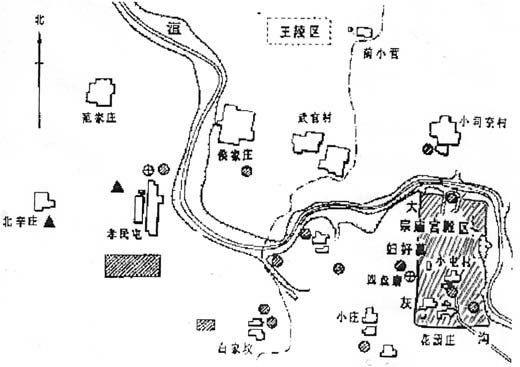
The "Great City of Shang" was located at a bend in the Huan River.