GRAMMAR COMMENTARY
50.1. An adverbial modifier of time expressed by the construction
with the word 後 hòu
Just as in the construction with the word 時 shí (48.2), 後
hòu can be preceded by a noun, a nominal phrase, or a predicative phrase:
王齋五日後 wáng zhāi wǔ rì hòu "after the king had fasted for five days."
50.2. Additional Predicatives Meaning
Direction of Movement (continued)
Above (44.3) we saw that the predicative 來 lái, attached to another predicative with an object, serves to indicate the direction of movement toward the speaker: 趙立奉璧來 zhào lì f èng bì lái "Zhao will immediately deliver the jasper."
In contrast to 來 lái, the predicative 去 qù indicates the opposite direction—away from the speaker: 左右或欲引相如去 zuǒ yòu huò yù yǐn xiàng rú qù "Someone from the retinue wanted to take [Lin] Xiangru away."
50.3. A construction like 從...以往 cóng... yǐ wǎng
(continued)
This construction can denote movement from a specific
point not only in space but also in time.
In the text of this lesson, it is used in the second meaning. The starting point is introduced here by the preposition 自 zì, and the direction is indicated by the predicative 來 lái (toward the speaker): 自繆公以來二十餘君 zì miào gōng yǐ lái èr shí yú jūn "the twenty-odd rulers, beginning with Miao Gong."
50.4. Adverbs (continued)
This lesson uses several more adverbs typical of classical Chinese, which are close to each other in their meanings.
卒 cù is used in two main meanings: "quickly," "immediately," and "eventually," "ultimately": 然卒破楚者此三人力也 rán cù pò chǔ zhě cǐ sān rán
lì yě "But ultimately, the state of Chu was defeated
by the efforts of these three men."
傾側擾攘楚魏之間,卒歸高帝 qīng cè rǎo rǎng chǔ
wèi zhī jiān, cù guī gāo dì "He wavered between Chu and Wei, and eventually went over to the side of Gao-di."
We encountered 終 zhōng in combination with 不 bù(終不 zhōng bù
"never..."). By itself, this adverb has the same meaning as 卒 cù, "in the end":
終必獲鄭,何必今日 zhōng bì huò zhèng, hé bì j īn rì "We will definitely capture Zheng in the end, why do we have to do it
today?" 立 lì is a synonym for 卒 cù in its first meaning, "immediately":
劍堅,故不可立拔 jiàn jiān gù bù kě lì bá "The sword got stuck
in its sheath, so it couldn't be drawn right away."
我有善則立譽我,我有過則立毀我 wǒ yǒu shàn zé lì yù wǒ, wǒ yǒu guò zé lì huǐ wǒ "If I do something good, praise me immediately, and if I make a mistake, scold me for it immediately."
50.5. The Phrase "因而 yīn ér"
It was noted above (44.5) that in the late classical language,
the word "而 ér" can combine a predicate and a forward-addressed object with a preposition. However, the object with the preposition "因 yīn" can be omitted, leaving only "因 yīn" in its place. This gives rise to
the possibility of comparing the words 因 yīn and 而 ér, which gradually develop into the set phrase 因而 yīn ér with
the meaning "as a result of this," "for this reason":
俗之所欲因而與之 sú zhī suǒ yù yīn ér yǔ zhī "Therefore
give what is usually considered desirable."
LEXICAL COMMENTARY
50.A. "Fast for five days"
Before performing any ceremonial act, a ruler in ancient China would usually fast for a
certain period of time, abstaining from delicacies and wine. "After fasting and washing, one can make sacrifices to the Supreme Lord," said
Mencius.
50.B. "Ritual of the Nine Guests"
It's not entirely clear what exactly this special term meant during the Zhang Kuo era. It likely denoted a formal ceremony for welcoming foreign ambassadors, apparently a particularly solemn one.
50.B. Guangcheng Inn
In large cities during the Zhang Kuo era, there were inns for visitors (傳舍 zhuàn shè, literally "shifting lodging"), usually, like modern hotels, having their own
names.
50.G. Miaogong of Qin
There is no ruler with this title in the official genealogies of the House of Qin. Apparently, this refers to Mu Gong (659–621 BC). The Qin Zhao Wang was the twentieth ruler after Mu Gong.
Meanwhile, Lin Xiangru speaks of "more than twenty" rulers of this kingdom. Apparently, he includes in this number two Gongs who occupied the throne only briefly and were subsequently not included in the genealogical list.
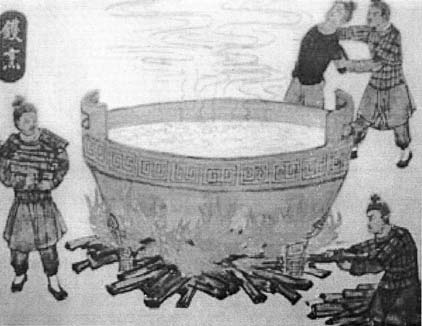
50.D. "Climbing into a Boiling Cauldron"
As a result of Shang Yang's reforms, extremely harsh laws were introduced in the Qin kingdom (mid-4th century BC). In particular, those who committed particularly serious crimes were thrown into a boiling
cauldron.