LEXICAL COMMENTARY
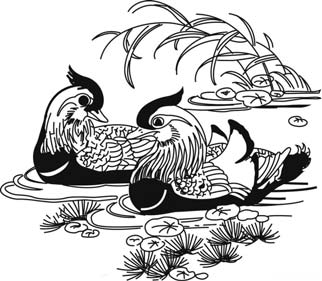
56.A. Mandarin Ducks
The image of two Mandarin ducks, always swimming together and never separated, symbolizes a happy couple in ancient Chinese poetry.
Among the new spatial markers appearing in the postclassical period, along with 裏 lǐ, some others should be noted, such as 旁 páng (傍 bàng) "near", "near...":
合葬華山旁 hé zèng huà shān páng "They were buried
in the same grave near Mount Huashan."
Although spatial markers are most often used
as postpositions, they also have some other functions. Thus, they can independently denote an adverbial modifier of place:
葉葉相交通,中有雙飛鳥 yè yè xiāng jiāo tōng, zhōng yǒu shuāng fēi niǎo "The leaves [of the tree] are intertwined, between them are two fluttering birds."
In post-classical Chinese, there is a significant expansion of the set of prepositions that was characteristic of classical Old Chinese. New prepositions are formed primarily from notional predicatives, so the process of forming these prepositions is marked by the coexistence of two different grammatical functions of a number of words: they are used both as predicatives and as prepositions.
One of the new prepositions is 向 xiàng. It derives from the predicative "to be addressed to..."; its function is to introduce an object indicating the object or person to whom the action is addressed.
In our texts, xiàng is used as a predicative:
吾獨向黄泉 wú dú xiàng huáng quán "Only I am turned
facing the Yellow Spring."
xiàng also occurs as a preposition:
轉頭向户裏 zhuǎn tóu xiàng hù lǐ "to turn one's head
toward the inner chambers."
xiàng with an object denoting the face:
汝今何故不向我道 rǔ jīn hé gù bù xiàng wǒ dào "Why
then don't you tell me anything now?"
向象三説我不須汝 xiàng xiàng sān shuō wǒ bù xū rǔ
"He said to the elephant three times: 'I don't need you.'"
Note that the preposition 向 xiàng forms an object that appears both before and after the predicate.
Along with the well-known 然 rán "to be like this," in ancient Chinese, starting from the classical period, a place predicate with the same meaning was used — 爾 ĕr.
In our text, both of these words appeared in the same
sentence:
君爾, 妾亦然 jūn ĕr, qiè yì rán "This is the case with both
you and me."
The image of two Mandarin ducks, always swimming together and never separated, symbolizes a happy couple in ancient Chinese poetry.