GRAMMAR COMMENTARY
57.1. The shì (continued)
The story told in this lesson is known in at least two manuscripts. The first is a collection of parables
"Stories of the Extraordinary," likely compiled by the famous statesman and writer of the Three Kingdoms period, Cao Pei (186–226). The second is the excerpt cited in the lesson
from "Records of Spiritual Searches," compiled in the 4th century.
Interestingly, the same plot is told in these two versions using language that reveals some grammatical differences. These differences concern, in particular, the ways of expressing the relationship
between the subject and the predicate.
Cao Pei's version uses the old lyric as a connective tissue.
也 yě: 夜行逢鬼,問曰誰,鬼曰鬼也 yè xíng f éng guǐ, wèn
yuē shuí, guǐ yuē guǐ yě "[Song Dingbo] was walking one night and met the soul of a deceased person. He asked it: "Who are you?" The soul
answered: "[I am] the soul of the deceased."
In the second, later version, the copula in a similar
sentence is not 也 yě, but 是 shì: 夜行逢鬼,問之,鬼言我是鬼 yè xíng f éng guǐ, wèn zhī, guǐ yán wǒ shì guǐ "[Song Dingbo] was walking one night and met the soul of the deceased. He asked it ["Who are you?"]. The soul replied: "I am the soul of the deceased."
At the same time, in some other sentences in our text, the link is completely absent: 我新鬼, 故身重耳 wǒ xīn guǐ, gù shēn zhòng ěr "I am the soul of the recently deceased, so my body is heavy, that's all!"
57.2. Function word 復 fù
The primary meaning of the function word 復 fù is "again," "again,"
"also"; When combined with negation, it translates as "no longer...":
不復聽之 bù fù tīng zhī "I didn't listen to him anymore."
The second meaning of 復 fù brings it closer to 則 zé (when the latter occupies a position between the subject and the predicate, expressing some kind of opposition or logical turn of thought):
逢鬼,問之,鬼言我是鬼,鬼問汝復誰 f éng guǐ, wèn zhī, guǐ yán wǒ shì guǐ, guǐ wèn rǔ fù shuí "Met the soul of the deceased. He asked it [“Who are you?”]. The soul answered: “I am the soul of the deceased.” [Then] the soul asked: “And who are you?”
57.3. The functional word 將 jīang
In the post-classical period, the functional word 將 jīang acquired some new meanings.
This word, in particular, can convey the speaker's uncertainty about the veracity of their statement and can be translated into
English by the words "probably" or "perhaps":
卿太重,將非鬼也 qīng tài zhòng, jiāng fēi guǐ yě "You
are too heavy, you are probably not the soul of the deceased."
57.4. Indicator of Redundant Degree of Quality
In addition to the superlative degree of quality, in post-classical times, its redundant degree could also be expressed. For this, as in modern Chinese, the adverb 太 tài "too much" is used:
步行太遲 bù xíng tài chí "Walking too slowly."
卿太重 qīng tài zhòng "You are too heavy."
57.5. The Phrase "當時 dāng shí" as an Adverb of Time
Noun phrases with "時 shí" used to denote
adverbs of time (當是時 dāng shì shí, 當...時 dāng... shí
etc.) can be used in a shortened form, being reduced
to "當時 dāng shí "at that time":
當時石崇有言 dāng shí shí chóng yǒu yán "At that time
Shi Chung used to say..."
LEXICAL COMMENTARY
57.A. Song Dingbo of Nanyang
In ancient China in the last centuries BC, it became customary to indicate a person's place of origin when mentioning them.
This was due to the fact that censuses were already conducted during the Han Dynasty, which indicated a person's affiliation with a particular administrative unit.
Nanyang is the name of one of the counties that existed in China
since the Qin Dynasty. This county was located in the southwestern part of modern-day Henan Province. The capital city of
Nanyang County is Wan.
57.B. Good and Evil Spirits
The ancient Chinese believed in the existence of good and evil spirits (神 shén and 鬼 guǐ), into which the souls of the deceased would transform.
Adventures involving evil spirits—the souls of the dead—became a favorite
plot in xiaoshuo novels during the Southern and Northern Dynasties.
Evil spirits (鬼 guǐ) appear in human form, but differ from humans in that they move completely silently
and weigh nothing.
On the other hand, in the first centuries of the Common Era, atheistic ideas developed in China, denying the immortality of the soul and the afterlife. The philosopher Fan Zhen is famous for his treatise on this topic.
57.B. Fifteen Hundred Coins
The oldest metal coin appeared in China during the Zhanguo era. Various coin types were common in the kingdoms of
that time: in the eastern kingdoms, they were shaped
like knives, in the central kingdoms, spade-shaped coins, and in the west, round disks with a hole.
After Qin Shi Huang unified the country, he carried out a reform aimed at unifying the monetary unit.
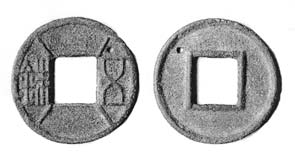
A round coin with a square hole became the unified standard, circulating throughout the country.
Subsequently, this coin became traditional in China. It was
cast from bronze and had a constant weight denomination, usually indicated in an inscription on it.