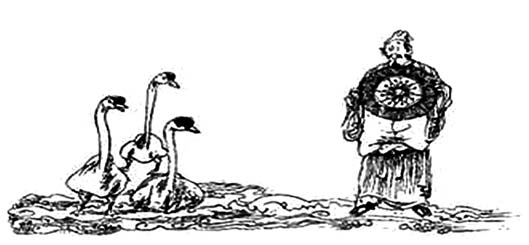
Студент попросил посадить его в клетку с гусями
(современный рисунок)
The post-classical period of the development of the ancient Chinese language is marked by an increased role for postpositions used to form adverbial clauses of place. The appearance of such postpositions makes the presence of a preposition optional:
云脚痛, 求寄鵝籠中 yún jiǎo tòng, qiú jì é lóng zhōng "He said his legs hurt and asked to be put in the cage with the geese."
諸銅器悉納口中 zhū tóng qì xī nà kǒu zhōng "He put all the bronze utensils in his mouth."
奩子中具諸饌殽lián zǐ zhōng jù zhū zhuàn yáo "There was an abundance of food in the chest."
However, in some cases, the adverbial modifier of place is formed by both a postposition and a preposition. Compare the following two sentences:
口中吐一銅盤 kǒu zhōng tǔ yī tóng pán "He spat out a bronze dish from his mouth."
於口中吐一女子 yú kǒu zhōng tǔ yī nǚ zǐ "He spat out a girl from his mouth."
It remains to be added that an adverbial modifier of place may not be formed by either a postposition or a preposition:
女子口吐一錦行障 nǚ zǐ kǒu tǔ yī jǐn xíng zhàng "The girl spat out the brocade screen from her mouth."
The appearance of the function word 都 dū in the post-classical period should also be considered one of the most characteristic features of the development of the Old Chinese language at this stage of its history.
The word 都 dū is used in texts from the 3rd–5th centuries in two meanings.
First, in negative sentences, dū has an intensifying meaning and corresponds to the English "absolutely," "completely":
都不生草木 dū bù shēng cǎo mù "Grass and trees don't grow at all."
都不覺重 dū bù jué zhòng "I didn't feel the heaviness at all."
Second, dū functions as a generalizing word. It indicates that the action expressed by the predicate applies to all objects or persons denoted by the subject:
牙莖枝葉一切都失 yá jīng zhī yè yī qiè dū shī "Sprouts, stems, branches, and leaves—all perished."
If the object is at the beginning of the sentence, the word 都 dū can also refer to the object:
四海之内都可克獲 sì hǎi zhī nèi dū kě kè huò "You can obtain everything that lies between the four seas."
都 dū can also be used with a nominal predicate:
一國都是女人 yī guó dū shì nǚ rén "In the state, everyone was women."
Incidentally, the fact that the function word 都 dū appears in the text of the treatise "Liezhi" (along with other considerations) gave the Chinese linguist Yang Bojun grounds to assert that this work was at least partially written not in the pre-Han period, but during the Southern and Northern Dynasties.
If the indicated number cannot be determined with sufficient precision, post-classical languages use special methods to indicate an approximate quantity.
One such method is to use the word kě before a numeral:
飮可五六斗, 徑醉矣 yǐn kě wǔ liù dǒu, jìng zuì yǐ "I'll drink 5-6 dou and only then will I get drunk."
衆可數十萬 zhòng kě shù shí wàn "The population is approximately several hundred thousand."
小女年可十二 xiǎo nǚ nián kě shí èr "The little girl was about twelve years old."
Another way to indicate an approximate quantity is to place the word 許 xǔ after the numeral (before the name):
飲十許日 yǐn shí xǔ rì "Drank for ten days."
可容三千許人 kě róng sān qiān xǔ rén "Could accommodate three thousand people."
往來二十許年 wǎng lái èr shí xǔ nián "Traveled for twenty years."
If the quantity If the number slightly exceeds the exact figure, the word 餘 yú is placed after the numeral:
羊百餘 yáng bǎi yú "more than a hundred rams."
Finally, these ways of expressing approximate quantities can complement each other:
出居延北可千餘里 chū jū yán běi kě qiān yú lǐ "to travel approximately a thousand-odd li north of Juyang";
可廣二尺餘 kě guǎng èr chǐ yú "approximately two-odd chi" "in width."
In post-classical languages, this word is often used with predicatives denoting movement. It introduces an object indicating that the subject is performing an action jointly with other people:
將五百賈客入海采寳 jiāng wǔ bǎi gǔ kè rù hǎi cǎi bǎo "He went to sea with 500 merchants to seek treasure."
將夫人出國逃走 jiāng fū rén chū guó táo zǒu "He fled the country with his wife."
Furthermore, a characteristic and specific feature of the word 將 jiāng is its use to form the inversion of a direct object:
我欲將汝作為善友 wǒ yù jiāng rǔ zuò wéi shàn yǒu “I want to consider you my good friend.”
The word 向 xiàng is not only a preposition, but also an adverb meaning “originally”, “previously”, “before”:
shǐ zhě yuē xiàng dù wǎn líng pǔ lǐ, mǎ wǎn zú, shì yǐ bù dé sù "[Li] Nan asked why he was late, and the messenger explained, 'I had just passed through Puli in Wanling, and my horse twisted its ankle, so I couldn't hurry.'"
The phrases 俄而 é ér and 須臾 xū yú are used as conjunctions indicating sequence of actions:
俄而書生醉臥 é ér shū shēng zuì wò "Soon after this, the student became drunk and went to bed."
We've already encountered phrases indicating a change in the degree of a particular quality: 加多 jiā duō "to increase in number," "to become more numerous," 加少 jiā shǎo "to become even fewer in number."
Similar phrases are also used in post-classical texts, but their first component is different—更 gèng "to change." Hence, 更廣 gèng guǎng "to become wider," 更小 gèng xiǎo "to decrease in size," etc.
陽羨 yáng xiàn "Yangxian" (county name)
許彥 xǔ yàn "Xu Yan" (proper noun)
綏安山 suí ān shān "Suianshan" (name of the mountain)
書生 shū shēng "student"
戲言 xì yán "to joke"
宛然 wǎn rán "really, indeed"
薄設 bó shè "to arrange a modest treat"
奩子 lián zǐ "little chest"
饌殽zhuàn yáo "dishes"
珍羞 zhēn xiū "exquisite dishes"
Yangxian County belonged to Wu County in what is now Jiangsu Province. The county seat was located near Yixing. Mount Suianshan and the city of the same name are located nearby.
Yongping — the reign of Emperor Ming Di (Eastern Han Dynasty), corresponding to 58–75 CE.